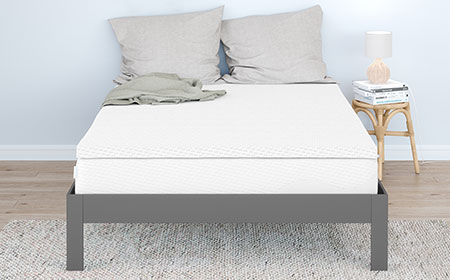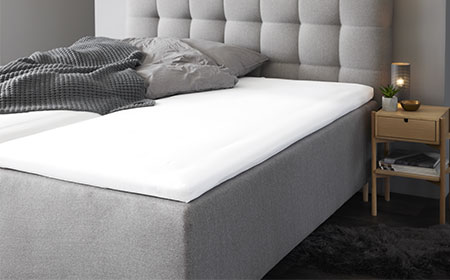
At JYSK, we have a large selection of mattress toppers and no matter your budget or preferences, we can help you find one that suits your needs.
In this article, you will find an extensive mattress topper guide on everything you need to know when choosing your new mattress topper – from material to quality, size, and price.
1. What is a mattress topper and what does it do?
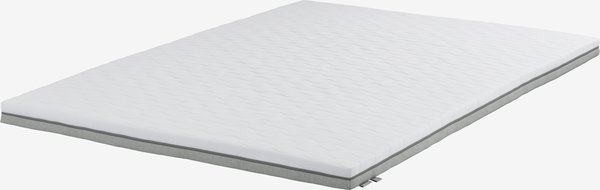
A mattress topper is a supplement to your regular mattress. It is placed on top of a regular mattress and comes in different sizes and prices. Mattress toppers are made of different materials and have different properties, but their purposes are always the same:
- To adjust and improve the overall comfort of your bed and ultimately to improve your quality of sleep.
- To protect the underlying mattress so it can last longer.
Both new and old beds can benefit from a mattress topper. We recommend that you evaluate the comfort of your bed after 5-10 years. This is primarily because our bodies typically undergo physical changes over the course of 10 years. If your weight has changed since you bought your bed, it can affect whether the mattress topper is still providing you with proper support and comfort.
"Evaluate the comfort of your bed after five to ten years. Does it hurt when you sleep? If so, that is a sign that you could benefit from a mattress topper. If you need to make major changes to the comfort level, for example, if you want a much softer bed, then you'll probably need a new mattress rather than a mattress topper."
– Peter, Category Manager at JYSK
2. Advantages of a mattress topper
Improved comfort: A mattress topper can give new life to an old mattress that has developed indentations or lost some of its elasticity. If you have a newer mattress that feels a bit too firm or too soft, you can adjust it by adding a mattress topper.
Prolonged durability: A mattress topper protects your underlying mattress against moisture, sweat, and stains, and can prevent it from developing indentations. A mattress topper will prolong the life of your underlying mattress and thus your entire bed.
More support: The right mattress topper can give you a more stable and supportive surface to sleep on. This can be beneficial for people who suffer from lower back or shoulder pain.
Less noise and movement: If you are bothered by creaking sounds from your mattress, a mattress topper can help dampen the noise. A mattress topper can also help absorb the movements of someone sleeping next to you.
An affordable alternative to a new mattress: A mattress topper is generally a much more affordable solution than buying a new mattress.
Improved pressure relief: When you lie on a mattress, you put pressure on different parts of your body depending on your sleeping position. This happens night after night. If your mattress doesn't relieve pressure in the areas where you need it to do so, it can cause pain and a poor sleep. A mattress topper can provide better relief to the affected parts of your body.
Help during warm nights: If you feel too warm at night, a mattress topper with cooling features can help solve the problem.
3. What should you consider when choosing a mattress topper?
The most important thing when selecting a mattress topper is to find a model that feels comfortable to you and gives you the support that your body type needs.
First, put some thought into the specific qualities you are looking for in a mattress topper:
- If you prefer a soft and sinking feeling, you should choose a mattress topper made of memory foam, Gel foam or Comfort+ foam.
- If you prefer a firmer, more stable surface, you should choose a polyether foam or latex mattress topper.
"What makes a good mattress topper is up to each individual and is very much a question of personal preferences."
- Peter, Category Manager at JYSK
Mattress topper types and materials
The properties of a mattress topper are largely dependent on the material that makes up its core.
The most popular materials used in a mattress toppers are:
Polyether foam (standard foam)
- Also known as regular foam, standard foam, PU foam or PUR foam
- Makes for an absorbent and generally affordable mattress topper
- As a general rule, a mattress topper made of polyether foam will only add a marginal amount of extra comfort. Its primary function is to protect the underlying mattress.
High resilience foam (cold foam)
- An oil-based foam, resulting in a medium-firm to firm mattress topper
- Moisture-absorbing and ventilating material
- Affordable and very durable
- Provides additional comfort to your bed setup
Hybrid foam and gel foam
- Hybrid foam is made of several types of foam. When it comes to comfort, it is positioned between polyether foam and memory foam.
- Gel foam is a soft foam that shapes to your body contours and provides you with a cloud-like comfort
- Both hybrid foam and gel foam cost roughly the same as memory foam
- Both materials provide very good comfort
Memory foam
- Of all mattress topper materials on the market, memory foam, gel foam and latex are the materials which contribute with the most comfort
- The material adjusts itself to the shape of your body when you are lying on it
- Provides a sinking and enveloping feeling
- Is not as good at releasing heat as other types of material, so a memory foam mattress topper is probably not the best choice if you often feel warm in bed
Latex (artificial latex and natural latex)
- While latex can be synthetic, natural latex is a completely natural material made from the sap of rubber trees
- Mattress toppers are usually made of a combination of natural and artificial latex
- As a hypoallergenic material, the presence of bacteria and fungi is minimised.
- Effectively releases excess heat, making it a good choice if you tend to feel warm when sleeping
- 100% natural latex generally costs more than other mattress topper materials. The higher the percentage of natural latex, the more expensive the mattress topper will be.
Mattress topper size
A mattress topper can be anywhere from 2.5 cm to roughly 10 cm high. Most models have a height – also known as core depth or thickness – between 3 and 5 cm. A higher mattress topper will have a greater effect on your bed and sleeping setup as a whole.
The width and length of a mattress topper should match the size of the underlying mattress. This is primarily a matter of comfort, but it also makes your bed look better. It is always a good idea to double check the dimensions of your bed to ensure that you will not end up with a mattress topper that does not fit your sleeping setup. Size is also important when you want to ensure that your new mattress topper doesn’t slide around on the mattress.
Mattress topper firmness
Once you have put some thought into your personal preferences, you can match them with our general recommendations for how firm or soft your new mattress topper should be.
- If you have a sleeping setup with a soft bed that you would like to make a bit firmer, you can choose a memory foam or polyether foam mattress topper.
- If you have a sleeping setup with a firm bed that you would like to make a bit softer, you can choose a latex or Comfort+ foam mattress.
To ensure that you end up choosing a mattress topper that will fulfil your needs, it is a good idea to visit a JYSK store and try it out before you make a decision.
Characteristics of a firm mattress topper:
- Low flexibility and elasticity
- Lower ability to adapt to your body
- Example: A 5 cm thick mattress topper made of memory foam or polyether (PUR) foam
Characteristics of a medium-firm mattress topper:
- Medium flexibility and elasticity
- Medium ability to adapt to your body
- Example: A 3 cm thick mattress topper made of memory foam or polyether (PUR) foam
Characteristics of a soft mattress topper:
- High flexibility and elasticity
- Higher ability to adapt to your body
- Example: Mattress topper made of gel foam or comfort+ foam
Which mattress topper is best for your sleeping position?
Your preferred sleeping position plays a role in which mattress topper you should pick. Different persons have different habits and support needs, and some materials are better at fulfilling those needs than others. The underlying mattress is the most important factor, but as a rule of thumb we can say:
- Most back sleepers will feel more comfortable with a mattress topper that makes the bed a bit firmer. This could be a 3 cm thick memory foam mattress topper, for example.
- Side sleepers may get more comfort out of a mattress topper that makes the bed softer, like a 3 cm thick latex mattress topper, for example.
- If you fall asleep on your stomach, you may need a mattress topper with extra deep shoulder zones.
4. Why buy a mattress protector?
A mattress protector, is significantly thinner than a mattress topper and primarily serves a hygienic purpose. An advantage of a mattress protector is that it is very easy to clean. A mattress protector will also extend the life of your underlying mattress by absorbing moisture and dirt before it reaches the mattress.
With a mattress protector, you:
- get an affordable solution that will not significantly change the way your bed feels
- can extend the life of your mattress by protecting it against moisture, sweat, and dirt
- make it easier to keep your sleeping environment clean. In contrast to most mattress toppers, mattress pads can go in the washing machine.
The combination of a mattress topper and a mattress protector is an ideal solution that protects both your underlying mattress and makes it easy to keep a hygienic sleep environment. Both products help you get the most out of your bed in the years to come.
5. Cleaning and allergies
Ideally, you want a sleeping environment that is easy to keep clean. When it comes to cleaning, a mattress protector will always be recommended. It can be machine-washed, making it much easier to clean than a mattress topper.
Some mattress topper have a removable cover that can be taken off for cleaning. These models are usually a bit more expensive, but they are particularly good for those who are allergic to things like dust mites.
The most effective method for keeping dust mite allergies in check is to have both a mattress pad and a mattress topper with a removable cover that can tolerate frequent washings at 60°C.
6. The best mattress toppers and mattress protectors
If you are looking for a mattress topper or a mattress protector, you have likely discovered that there are many models to choose from. At JYSK, we are always ready to advise you on your purchase so you can choose a model that fits your needs, sleeping position and budget.
You can also read our other guides with inspirational tips and advice that will help you create the best possible sleeping environment for you.
If you do decide that it is time for a new mattress, rather than a mattress topper or a mattress protector, read our extensive mattress guide.